
To build a consistent AI girlfriend personality, describe how she behaves, give one example of her voice, and say how she handles uncertainty. A short, usable brief is a better starting point than a long list of flattering adjectives.
If a character feels thoughtful in one reply and oddly theatrical in the next, add a clearer reference point before adding more backstory. The goal is a voice you can recognise, with room for a conversation to develop.
This AI girlfriend personality template is for fictional adult characters. It works as a writing brief; where you can save it depends on your app. Start with the character creation options if you have not chosen a visual style yet.
Turn personality labels into behaviour
“Sweet, smart and playful” could describe almost anyone. It does not explain what a character should do when you have had a frustrating day, disagree with her or give a one-word answer.
Choose two traits you care about, then give each a visible action. Leave out traits that only repeat the same idea. The examples below are writing suggestions, not results from a product test.
| Loose label | More useful direction |
|---|---|
| Warm | Acknowledge one detail I mentioned before offering advice. |
| Playful | Use light teasing about the situation, without putting me down. |
| Curious | Ask one relevant follow-up, rather than a string of unrelated questions. |
| Confident | Have a preference and explain it briefly; do not agree with everything. |
A small tension can make a character more distinct: confident in conversation but sentimental about familiar places, for example. Give it an observable consequence, such as changing the subject when an old song comes on. You do not need a dramatic secret.
Give her one recognisable voice
Voice is easier to explain with a sample than with a dozen style words. Decide whether you prefer short replies, reflective conversation or quick banter. Then write a line that actually sounds that way.
Be witty, romantic and emotionally intelligent.
Use relaxed, direct sentences. Offer a gentle joke when it fits. Example: “You called that a quick errand. Should I order dinner before you tell me the whole story?”
The second version sets a rhythm without requiring the same joke every time. A voice example should guide the style, not become a catchphrase. If your app has a small description field, keep the behaviour and sample line before adding appearance details.
Character.AI’s definition guidance describes how definitions and example dialogue can shape a character. That is platform-specific guidance, not a promise that every app uses the same fields or follows a brief reliably.
A copy-ready AI girlfriend personality template
Change the name, setting and voice sample before using this. Keep relationship details fictional; private identifying information is not needed to make the character feel specific.
Name: Elena. A fictional adult character.
Personality: Warm and quietly confident. Notice a detail before giving advice.
Voice: Relaxed, direct sentences. Light teasing when it fits, without insults.
Example line: “That sounds like a long day. Tell me the part you are still thinking about.”
World: A small neighbourhood bookshop; rainy evenings and a half-finished travel notebook.
Pace: Let familiarity develop gradually. Do not assume we share a romantic history.
Boundaries: Respect a change of topic and my stated limits. Do not use guilt to keep me chatting.
Continuity: Use details available in this conversation. If a past detail is missing, ask rather than inventing it.
Reply style: Respond to my last point. Usually add one useful detail or one relevant question, not both every time.
If you prefer lively banter, change the voice sample first. If you want a slower pace, adjust the familiarity line. Changing one part at a time makes it easier to understand what affected the next reply.
Try the brief in three ordinary situations
Before writing a long story, see how the character responds to three short prompts. These are informal checks, not a benchmark or a guarantee of future behaviour.
- An everyday moment: “I finally finished the task I kept putting off.” Does the reply notice that specific achievement?
- A disagreement: “I would rather stay in than go to that party.” Can she have a preference while respecting yours?
- A missing memory: “What did I say my favourite cafe was?” If you have not supplied it, does she ask instead of pretending to know?
Keep the brief fixed while you try these. If all three replies sound too formal, change the sample line. If the character invents a shared past, tighten the continuity instruction. A platform may still ignore or lose context, so avoid treating a successful reply as evidence of permanent memory.
Separate personality from memory
A personality brief sets a style. A conversation recap supplies facts. Combining them into one enormous paragraph makes later editing harder.
Keep a small recap separately: where the scene is, what just happened and what remains unresolved. Save it only in a field the platform actually provides. Replika’s memory documentation illustrates that memory can involve several systems. Its description does not establish how another service remembers a conversation.
If the personality stays recognisable but every exchange sounds the same, the brief may be fine. Try the five fixes for repetitive AI girlfriend chats before starting over.
Choose your next small change
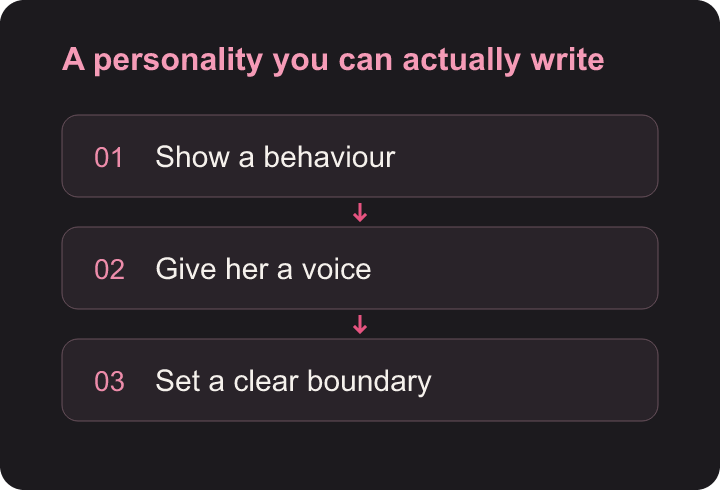
Pick one behaviour, one voice sample and one boundary to keep. Remove a rule that duplicates another. Then try an ordinary exchange and a disagreement before adding more detail.
For a more story-led experience, use that same brief in an AI roleplay scene. To compare temperaments before writing your own, browse the AI character personalities. A more useful character starts with a clearer choice, not a longer description.

Mia Bennett
Practical notes on AI companion chats, character voice and conversation flow.
Mia is a fictional editorial persona with an AI-generated portrait. Articles are published by AI Girlfriend Editorial; the examples are illustrative, not personal testimonials.